


Ameritherm logo
Applications Database

ISO 9001:2000 certified

Brazing


Applications Database
Links

Flameless heating with induction

Access these helpful Application Notes after a brief registration:
Heat a compacted litz wire bundle for stripping
Braze an end plug on a stainless steel car grill
Brazing joint on pressurized heater connectors
Brazing steel mold for golf ball dimple insert
Braze electrical contacts to brass and copper bus
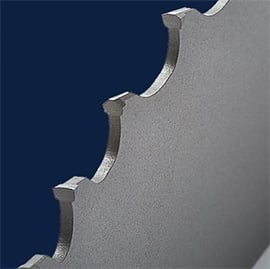
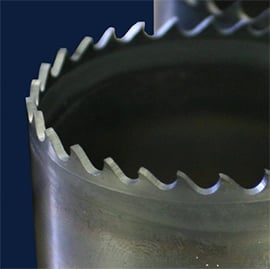
Braze a diamond carbide tip onto band saw blade
Braze a stainless steel braided hose to copper elbow
Braze a refrigeration tube coil assembly
Brazing stainless steel tree injector
Braze four copper bus bars together
Braze a carbide sleeve to a steel shank for a plug gauge
Braze steel O-ring Face Seal fittings to a steel tube
Brazing Steel-carbide Cutting Tool
Steel-carbide brazing
Brazing a Brass Trap Block
Brazing a Plumbing Union in Tight Quarters
Brazing Brass Fitting to Copper Tube
Brazing Faucet Components, Assemblies
Brazing Carbide Tips to a Meat Cutter
Braze a caride tip to a steel scraper
Brazing a Cutting Tool Assembly
Brazing a carbide shaft to steel tube
Brazing a Bourdon Tube Assembly
Brazing Brass Ship Fittings for Repair
Brazing carbide Tips on Drill Bits
Brazing Copper ‘T’ Assemblies
Brazing Steel Conduit to a Ferrule/Elbow Assembly
Brazing a Heat Sensing Probe
Brazing Steel Dental Tools
Brazing oil suction assembly with copper ring
Brazing Turbine Blades With Nickel
Brazing Hydraulic Hose Assemblies
Brazing Thin Steel Wires
Brazing Copper J Tube Into Fittings
Brazing An Eyeglass Frame Assembly
Brazing A Copper Tube To Brass Fitting
Brazing Steel Orthodontic Parts
Brazing Hyraulic Hose Assemblies
Brazing Copper Fittings to Refrigeration Valve
Brazing carbide rotary file to high speed steel shanks
Brazing carbide teeth to a steel pipe jaw section
Brazing carbide to steel for a surgical device
Brazing automotive tube assemblies
Brazing dental begg brackets
Heat aluminum for brazing an automotive assembly
Brazing Diamond Drill Inserts
Steel-carbide brazing cutting tool

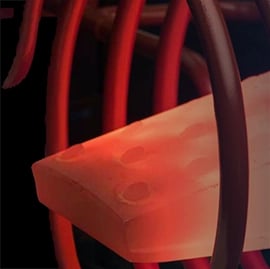
Brazing is one of many industrial applications for induction heating.
What is induction heating?

protective atmosphere brazing
Atmospheric Brazing


Overview

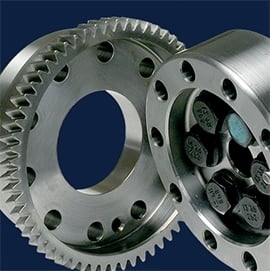
Brazing is a heating process in which two or more like or unlike materials are joined together by means of another metal alloy with a lower melting point. Braze joints can be made exceptionally strong, sometimes stronger than the two metals being joined.

Braze joints are liquid- and gas-tight, can withstand shock and vibration, are unaffected by normal temperature changes, provide good electrical conductivity and can be easily plated using conventional processes. Typical brazing temperatures vary between 800°F and 2150° F.

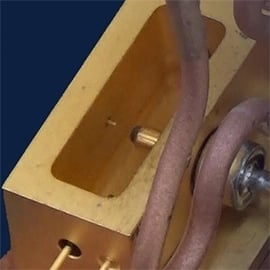
brazing brass to brass
Brazing Brass To Brass

Using Induction

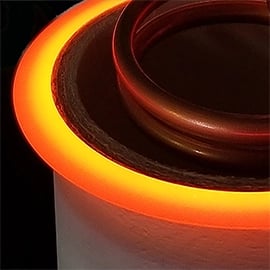
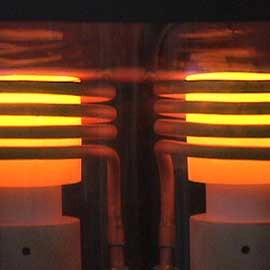
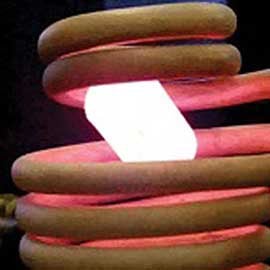
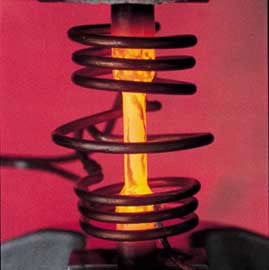
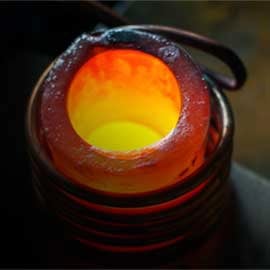
Modern induction heating provides reliable, repeatable, non-contact and energy-efficient heat in a minimal amount of time without flame. Solid state systems are capable of heating very small areas within precise production tolerances, without disturbing individual metallurgical characteristics. For larger volume applications and/or quality-dependent processes, parts can be brazed with induction under a controlled atmospheregas or mixture of gases in which steel is heated to produce or maintain a specific surface condition. without flux or any additional cleaning steps.Typical RF power supplies for induction brazing range from 1 to 20kW, depending on the parts and application requirements.


Customer
Links

These links highlight some of our valued customers using induction in their brazing processes

Edison Welding Institute

Kay and Associates


Setup

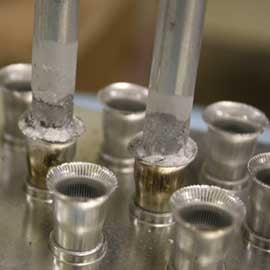
First, the two metals to be joined are cleaned by coating them with flux. The braze paste or preform is then put in position and heat is applied until the braze flows creating a solid joint.

If the braze is being stick fed, the parts are first brought up to temperature; then braze is introduced into the joint area by hand. The appropriate temperature depends on the type of braze that is being used.


Materials Needed

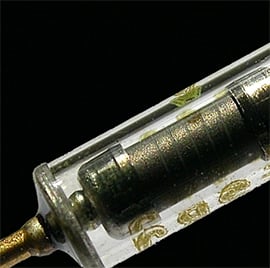
Braze: The alloy can be in paste, preform or stick form, depending on the application. A wire preform is generally preferred because it ensures uniform distribution and promotes joint-to-joint consistency. Different braze alloys have different heating characteristics; silver is frequently used for induction brazing because of its low melting point. Silver-copper eutectic brazes have melting temperatures between 1100°F and 1650°F. Aluminum braze, the least common, has a melting temperature of 1050°F to 1140°F. Copper braze, the least expensive, has a melting temperature of 1300°F to 2150°F.

Flux: The functions of flux are to dissolve the oxides formed during the heating process, shield the alloy and joint from oxidation, provide clean surfaces to promote even spreading of the alloy, and to promote alloy flow by capillary action a phenomenon associated with surface tension and resulting in the elevation or depression of liquids in capillaries . There are many different types of fluxes available for use at different temperature ranges. Black flux is used for high temperatures (up to 1800°F) and is good for steel brazing. White flux is most often used for lower temperature (1100°F to 1500°F) applications. Ideally, the flux should have a lower melting point than the base metal, and should be entirely liquid before the braze alloy melts.

Heat source: Fast, precise heating works best.


Common Problems

Braze does not flow consistently each time the joint is made.
Parts may crack after the braze is complete.
If the parts to be joined are at different temperatures, braze will not stick to the colder part.
The high temperatures required can cause distortion of the metals being bonded.


Tricks of the Trade

Both metals that are being joined together need to be of equal temperature during the brazing process for a successful braze joint.
A slower heating cycle is better then a faster one. If productivity rates are critical, it is better to process multiple parts at the same time.
When using a braze preform ring for induction brazing, make sure there is good physical contact between the part and the ring. A loose ring will need much higher temperature to melt and will also cause non-uniform joints.
The parts being brazed must be clean at the joint area.

Read Dr. Dahake's 8-Point Guide For Better Braze Joints

updated 8/5/2008

footer line
©1987-2008 Ameritherm Inc. - precision induction heating 39 Main St., Scottsville, NY 14546 USA, All rights reserved
Tel: 1-585-889-9000 Fax: 1-585-889-4030 info@ambrell.com